




The logistics sector serves as a vital link between businesses and consumers. Each day, an immense volume of goods moves across supply chains, flowing through warehouses, transit points, ports, and distribution facilities. Real-time inventory tracking, automated warehouse processes, and quicker deliveries are all made possible by digital technologies, ensuring packages reach their destinations efficiently.
As logistics operations increasingly rely on cloud platforms, IoT devices, WMS, TMS, mobile apps, and AI-powered automation, their vulnerability to cyberattacks grows. These operational advancements in logistics, while beneficial, also inadvertently create novel opportunities for cybercriminals intent on causing business disruption.
The nature of cyberattacks on logistics firms has expanded past simple data pilfering. Cybercriminals are increasingly aiming at supply chains, aiming to cripple operations through forced downtime or delivery disruptions. Furthermore, cybercriminals are now seeking to abscond with confidential business intelligence and extort cash via ransomware. Attackers can threaten any part of a supply chain because third parties are often used to facilitate processes, and a breach in one vulnerable vendor or application can affect the entire chain.
Logistics companies can’t afford to ignore cybersecurity. The protection of their digital assets, customer details, endpoints, operational systems, and all collaborating partners is now a vital requirement for ongoing business operations, not merely an IT concern. We’ll explore the top cybersecurity threats in the logistics industry in 2026, the surge in attacks, and how businesses can effectively respond.
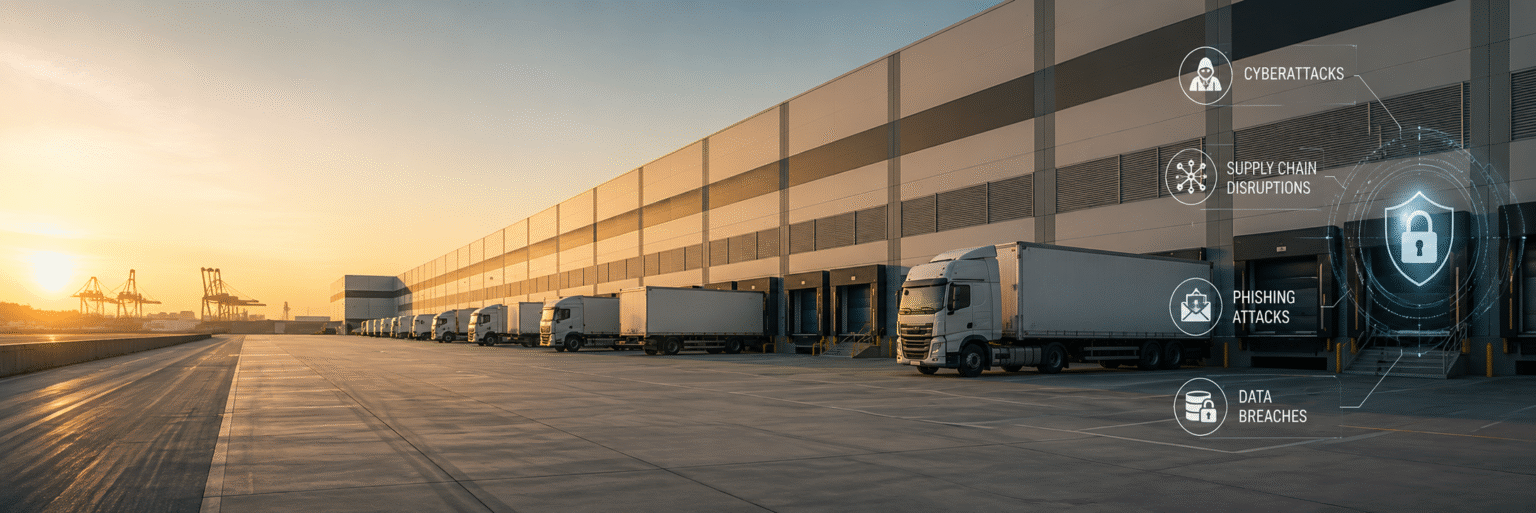
Cybercriminals find the logistics sector particularly appealing because it encompasses a wide array of companies, technological systems, and vital business functions. From start to finish, a shipment touches upon various entities like manufacturers, suppliers, carriers, warehousing operations, customs officials, and the ultimate recipients. A breach in one section of the logistics supply chain has the potential to compromise the entirety of it.
Additionally, the cyber risk in logistics is made worse by:
The way logistics and transport firms operate now involves a variety of linked applications, cloud infrastructure, APIs, IoT sensors, GPS tech, and mobile solutions. A successful intrusion into one system could enable an attacker to access further connected platforms.
Logistics companies often exchange crucial data with external partners such as freight forwarders, carriers, tech vendors, customs agents, and their own suppliers. Should a vulnerability exist within any of your third-party vendors’ systems, it could provide a pathway for infiltration into your organization.
In most industries, it’s feasible to wait out a ransomware infection or system outage. But for logistics, missing delivery windows, warehouses unable to take stock, disabled transport, and late customer fulfillment can prove incredibly costly.
Modern logistics companies are leveraging IoT sensors, self-driving and connected vehicles, robotic warehouse solutions, AI-powered route planning, and cloud-based systems to enhance efficiency. These technologies are vulnerable to cybercriminal attacks unless suitable security controls are established.
These companies in the transportation and logistics sphere routinely manage delicate information concerning their business operations and clientele, such as customer profiles, past shipments, financial transactions, inventory specifics, and supplier details. The information acquired by cybercriminals can be sold through dark web channels or exploited to carry out ransomware and extortion attempts.
Cybersecurity risks are very much a present danger for logistics businesses. As the supply chain becomes increasingly digitized and interconnected, cyber threats are, in reality, escalating in both prevalence and complexity. A ransomware incident has the power to cease all warehouse operations and disrupt tracking. Compromised APIs can leak shipment data.
Here are the top cybersecurity threats in the logistics industry that organizations need to plan for in 2026:
For businesses across the board, ransomware attacks consistently rank as some of the most devastating cybersecurity threats, and logistics companies are no exception to this trend. The attackers lock up vital systems and procedures, requiring payment to restore functionality.
For these companies, the impact can range from disrupted warehouse functions and shipment delays to immobilized fleet management and a complete cessation of business activities.
A ransomware attack could moreover damage a company’s standing, frustrate clients, and incur legal sanctions if personal details are compromised.
Ways to prevent ransomware attacks:
The success of cybercriminals’ phishing efforts is being boosted by AI. Cybercriminals are leveraging AI to effortlessly impersonate your customers, suppliers, or C-Suite staff through emails that appear almost identical to legitimate correspondence.
Cybercriminals aren’t just aiming for senior management; they’ve also been seen masquerading as common logistics business associates, like those in freight forwarding, finance, or vendor relations, to snag employee credentials or payment details. Among logistics companies, certain roles are particularly susceptible to attacks:
How to prevent AI-powered phishing:
For supply chain logistics, businesses count on a variety of third-party vendors, from freight carriers and customs agencies to cloud providers, software developers, and transport companies. A security incident with any of these suppliers could open a backdoor into your systems.
Supply chain cyberattacks via external suppliers are among the most quickly escalating security worries for supply chain operations.
Tips to reduce risk:
Most modern logistics software relies heavily on APIs as its bedrock. These interfaces enable seamless interaction between transport management systems, warehouse software, customer dashboards, payment processors, and mobile apps.
When APIs aren’t properly protected, sensitive details like shipment manifests, customer specifics, stock levels, and even how your business operates internally could be exposed. Hackers can breach your system through security flaws such as weak authentication, broken access controls, and exposed endpoints.
Tips to avoid API vulnerabilities:
Cloud tech has truly transformed how businesses in the supply chain operate. It provides a central hub for cooperation, supports working from anywhere, and makes scaling simple. Yet, a significant number of cybersecurity breaches stem from cloud setup mistakes.
Examples of cloud risks include:
Performing routine cloud vulnerability assessments can help mitigate these weaknesses.
Smart sensors, GPS devices, mobile scanners, RFID labels, CCTV, and fleet monitoring tools are just some examples of IoT devices used in logistics. These technologies allow companies to gain better visibility into their operations.
However, many of these devices are easily compromisable by cybercriminals. Some are installed using factory default passwords, and others are accessible via exposed interfaces.
Tips for securing IoT devices:
These Warehouse Management Systems (WMS) handle the flow of inventory, process orders, and oversee fulfillment tasks. Cybercriminals might exploit WMS platforms to corrupt inventory figures, hold up deliveries, disrupt automated warehouse processes, or pilfer confidential business intelligence.
To prevent such incidents from happening, security teams must:
TMS platforms are responsible for coordinating things such as route planning, fleet operations, carrier oversight, and tracking shipments. Should a TMS platform fall into the wrong hands, attackers might exploit it to deliberately slow down shipments, spread misleading delivery updates, or make off with confidential logistical information.
It’s crucial for businesses to conduct frequent assessments of their TMS applications for security flaws and vulnerabilities, while also guaranteeing that any APIs utilized by their business partners are secured.
Cybersecurity incidents aren’t solely the work of outside malicious actors. It’s possible for sensitive details to be compromised by individuals within your organization, like staff, contractors, or third parties, who possess valid system privileges. Such attacks might stem from deliberate actions or unforeseen errors.
Insider threats might arise from various circumstances, depending on the specific scenario.
Preventing insider attacks hinges on setting up least-privilege user access, monitoring both users and entities for unusual activity, and providing frequent cybersecurity awareness education.
Cyber risks are growing just as rapidly as digital transformation advances. Responding after a problem surfaces can result in significant business downtime, costly financial impacts, and a tarnished reputation that’s hard to repair.
A robust logistics cybersecurity program, featuring constant vigilance, scheduled VAPT, employee education, sound cloud configurations, and oversight of vendor risks, empowers logistics companies to lessen threats and ensure stable, continuous operations.
A lot of companies don’t really get how badly a cyberattack can mess with a logistics operation. Cyberattacks on logistics firms ripple out far beyond just their IT infrastructure, leading to shipment delays, communication breakdowns with clients and collaborators, and considerable financial strain across the entire supply chain.
These are some of the most severe business repercussions your company could experience.
When essential systems like your WMS, TMS, or shipment tracking software go down, daily operations can swiftly stop dead in their tracks.
Operational downtime can lead to:
The impact of a cyberattack disabling your systems, even temporarily, extends to your whole supply chain.
Cyberattacks, besides their operational toll, usually drain an organization’s finances.
Depending on the situation, your organization could be responsible for the costs of:
Each organization has vital data it endeavors to shield. This data might encompass customer details, shipping manifests, agreements with suppliers, billing records, and financial transaction specifics.
Exposed or stolen data can result in:
Supply chains essentially form interconnected webs linking producers, raw material providers, carriers, storage facilities, and end-users. Every stage of the supply chain relies on the one before it to keep products flowing and bolster sales.
The effects of a cyberattack on a single entity can extend to dozens of connected businesses.
Supply chain impacts can include:
Cybersecurity doesn’t have to be complicated. People, processes and technology are strongest when working together. Implementing these logistics cybersecurity best practices will strengthen your logistics organization’s defenses and enhance its ability to withstand disruptions.
Performing regular vulnerability assessments and penetration tests is crucial for identifying and rectifying security weaknesses before they can be exploited by malicious actors. By imitating real-world attacks, vulnerability scanning and penetration testing reveal weak spots across web applications, APIs, cloud infrastructure, internal networks, databases, and mobile applications.
These regular checks also contribute to meeting compliance requirements and bolster your entire security framework.
For companies with dispersed teams and interconnected digital supply chains, just defending the network’s edge isn’t adequate.
Under a zero trust security model, you must constantly verify users, devices, and applications before they’re allowed into your organization’s digital assets.
Key components of a Zero Trust model include:
Every organization’s security strategy needs to incorporate vendor cybersecurity. Third-party vendors, suppliers, and business partners are commonly part of logistics operations.
Recommended third-party risk management practices include:
To prevent security gaps from escalating into business risks, you need to perform frequent evaluations of your cloud infrastructure.
Things to look for include:
Logistics organizations still rely on their people as the primary defense. Ensuring your staff are well-informed through cybersecurity training and awareness initiatives is essential for them to understand:
A well-informed workforce significantly hampers attackers’ ability to compromise your systems.
Every organization’s digital footprint inherently contains weaknesses. The aim is to pinpoint and rectify these weaknesses before malicious actors can exploit them.
VAPT, or Vulnerability Assessment and Penetration Testing, is a key method for organizations to find security gaps early by running simulated attacks against their web properties, APIs, cloud resources, applications, networks, and databases.
For any logistics firm that operates web apps, APIs, third-party software, internal networks, mobile applications, or cloud platforms, your cybersecurity program should include regular vulnerability assessments and penetration testing.
For logistics firms operating across different countries and business areas, adhering to a range of cybersecurity and data privacy laws is highly probable.
The specific frameworks and regulations you’ll need to adhere to are determined by your business requirements. Common standards companies adhere to include:
By aligning with reputable cybersecurity frameworks, you can enhance security governance, control cybersecurity risks, and build greater customer trust.
To secure contemporary logistics, you need to do more than just provide security technology. At Cyber Security Hive, we work with logistics organizations to proactively identify vulnerabilities, improve security controls and build cyber resilience.
Our cybersecurity services include:
If your aim is to protect a warehouse management system (WMS), transportation management system (TMS), a logistics or supply chain customer portal, your cloud setup, or any other business application — we’ve got you covered.
The logistics sector is changing quickly, embracing digital tools to boost efficiency, enhance visibility, and improve supply chain connections. However, as digitization advances, so do cybersecurity threats in the logistics industry leading to costly operational disruptions, sensitive data breaches, and damage to your customer relationships.
Proactive cybersecurity measures are essential before an attack strikes your company. Regular security assessments, continuous network monitoring, secure cloud solutions, employee awareness training, and effective security risk management are key to protecting your business from evolving cyber threats.
Engage with Cyber Security Hive to proactively address new cyber threats and safeguard your vital operations right now. Reach out to us to set up a security assessment and discover how our VAPT and logistics cybersecurity consulting can shield your business from current threats.