




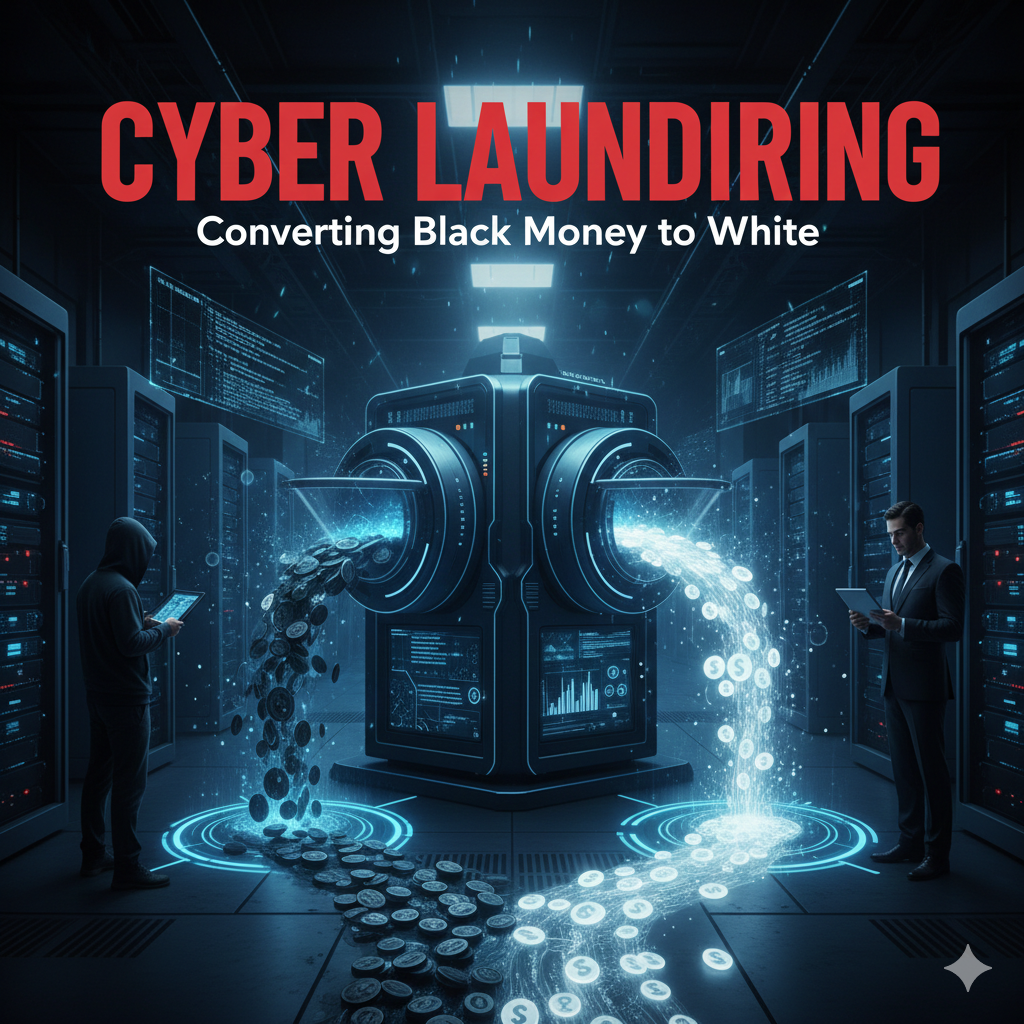
For many years, money laundering was primarily a physical activity. Concealing the existence, illegal source, or unlawful application of income—and disguising it to appear legitimate—required the launderer to physically transport large amounts of cash. With the advent of the internet, however, this process has significantly evolved. Today, cybercriminals increasingly use online platforms to legitimize illicit funds.
Money laundering involves any type of property or benefit, whether tangible or intangible, derived from criminal activity. The phenomenon of cyber laundering gained momentum with the introduction and widespread adoption of the internet, which criminals now exploit to conduct sophisticated laundering operations. The basic technological features that enable cyber laundering—such as fast processors, advanced computing systems, and high-speed internet access—have become essential catalysts in facilitating these crimes.
The virtual world provides an ideal platform for cyber laundering, especially in the era of globalization. As the world increasingly resembles a global village, financial access across borders has become as simple as a single click, making illicit transactions easier to conceal and harder to trace.
Cyber laundering exists at the intersection of two distinct fields: cybercrime and money laundering. Therefore, it is essential to examine cyber laundering through the correct legal lens in order to establish an effective regulatory framework.
If cyber laundering is treated purely as a cybercrime, it risks overlooking the fundamental element of money laundering. While cyber laundering has clear roots in cybercrime, it must primarily be addressed as a form of money laundering that employs technological tools. Treating cyber laundering merely as a technique of cybercrime would be inappropriate, as its core objective remains the concealment and legitimization of illicit proceeds.
According to various estimates, nearly 40 percent of the world’s population uses the internet, and this number continues to grow. The internet’s popularity lies in its capacity to store vast amounts of data, facilitate rapid communication, and enable seamless sharing of banking and trade-related information.
As financial operations increasingly rely on digital channels and new modes of payment, cyber laundering poses a serious challenge to financial regulators. Criminals can exploit these systems to evade detection, making it imperative to adopt effective countermeasures. One such method is the “4-I Approach.”
The 4-I approach emphasizes the following strategies:
Strengthening IT expertise is crucial for institutions to keep pace with cybercriminals. This includes advanced training for personnel and, in some cases, hiring former hackers to better understand criminal techniques.
Cybercriminals often operate anonymously. Improved online identity verification mechanisms can help reduce anonymity and deter illicit financial activities.
Although skilled users can mask their identities through proxy servers and anonymization tools, financial transactions should never be conducted anonymously. Enhanced IP tracking of online payments is essential to prevent criminals from concealing their digital footprints.
Cybercriminals exploit jurisdictional boundaries and international cooperation gaps. Strengthening national and international collaboration is vital to effectively combat online money laundering and terrorist financing.
In 1986, the Money Laundering Control Act was introduced to curb the structuring of transactions designed to evade reporting requirements. The Act sought to close loopholes that allowed such practices to flourish. By criminalizing transaction structuring, lawmakers aimed to strike criminals “where it hurts most—their finances.”
Under this Act, banks are required to file Currency Transaction Reports even if an employee merely has knowledge of attempted structuring. While these measures initially constrained traditional laundering methods, criminals soon adapted by turning to electronic fund transfers.
Wire transfer systems provide criminal organizations, legitimate businesses, and individuals with a relatively low-risk means of transferring funds across borders. Federal agencies estimate that up to $300 billion is laundered annually worldwide. As massive volumes of computerized financial data accumulate, investigators face increasing workloads, making detection and enforcement more challenging.
The Budapest Convention on Cybercrime (2001) forms the cornerstone of international cybercrime legislation. It requires State Parties to:
The Cybercrime Convention Committee (T-CY) was established to facilitate information exchange among parties and to consider amendments to the Convention. In 2006, the Council of Europe launched the Global Project on Cybercrime to assist nations in strengthening legislation, training law enforcement and judicial authorities, promoting public–private cooperation, and protecting personal data and children from exploitation.
The European Police Office (Europol) has also developed a comprehensive cybercrime strategy. The European Cybercrime Centre currently provides operational and analytical support for numerous investigations into payment fraud. In 2013 alone, Europol assisted in dismantling multiple international credit card fraud networks, resulting in dozens of arrests, seizure of cloned cards and cash, and the disruption of organized criminal groups affecting tens of thousands of victims across Europe.
The rapid spread of computer and communication technologies, along with the digitalization of nearly every aspect of life, has blurred national boundaries and interconnected global economies. This has led to the emergence of an integrated global information environment where individuals can manage personal and corporate information remotely, without face-to-face interaction.
Despite growing awareness of cybercrime, the absence of physical contact, coupled with anonymity, has significantly increased cyber laundering activities. An effective anti-cybercrime strategy must involve a coordinated blend of legal, technical, organizational, and informational measures, with none being secondary to the other.
Early detection and proactive enforcement are critical, and these efforts require strong international cooperation as well as collaboration between public and private sectors. Only through such a comprehensive approach can cyber laundering be effectively addressed.