




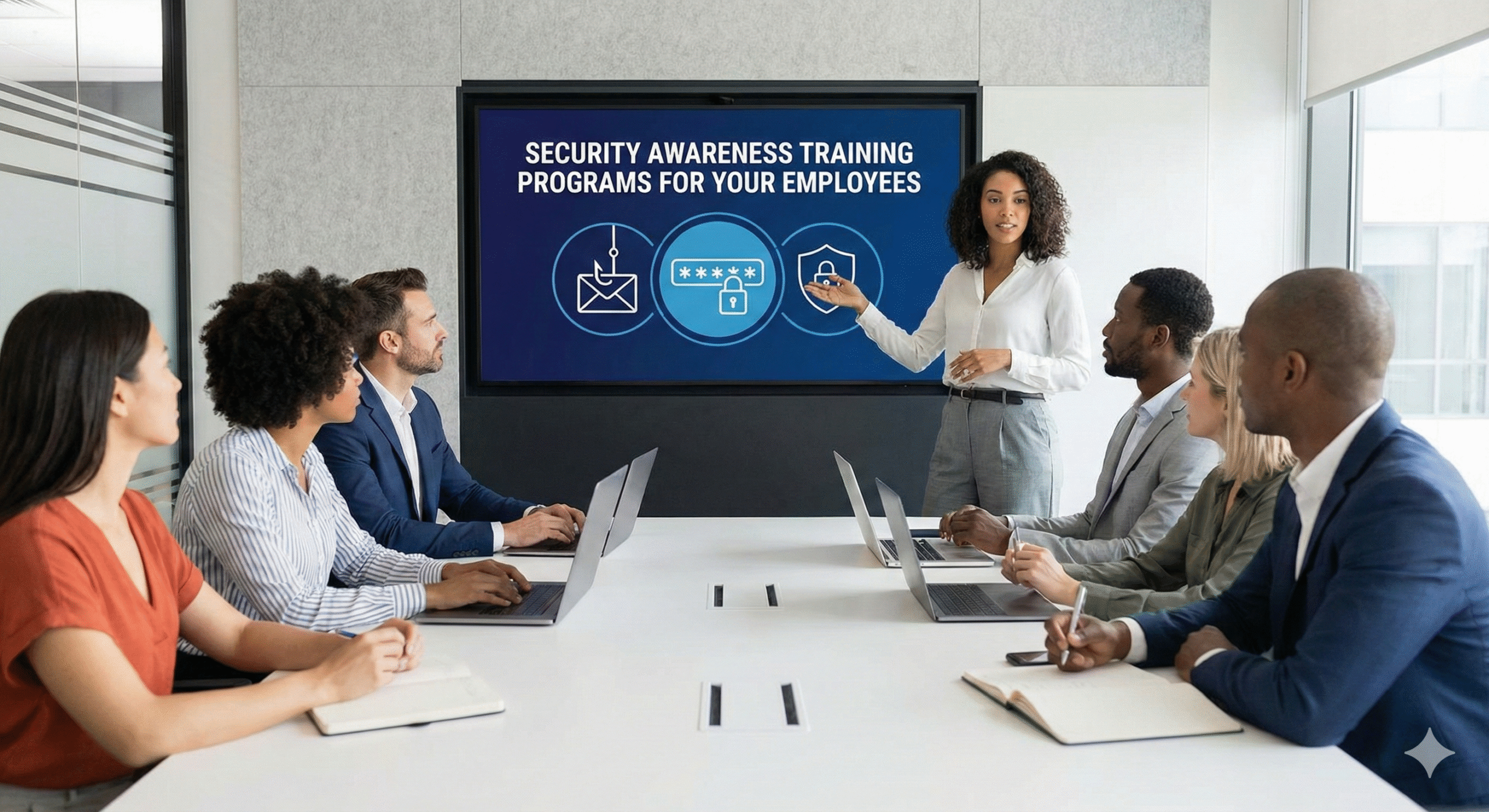
In our technology-driven society, nothing is worse for an organization than the headline, “XYZ Company Hacked, Passwords Stolen.” Customers lose trust instantly when they hear about breaches like these and think twice before doing business with the damaged company. Often times, these attacks are successful due to employee ignorance regarding phishing emails, ransomware, or malicious links. The bad guys know how to spoof warning signs in emails, phone calls, and text messages and your employees may not know how to identify these attacks. One of the most important steps your organization can take to protect against cybercriminals is implementing security awareness training programs for employees.
In this article, we discuss what security awareness training is, why your organization needs security awareness training, and how to build a successful security awareness training program.
A security awareness training program is often one component of your company’s larger defensive strategy. Ideally, these programs prevent cyberattacks before they happen by empowering every employee to understand what kinds of attacks to look out for and how to stay alert at all times. Security awareness training covers both information security and cybersecurity while reinforcing the idea that everyone is responsible for security—not just the IT Team.
When everyone owns security, employees become increasingly cyber-aware and do their part to prevent attacks against your business.
Attackers are getting smarter every day and many times utilize human nature to get what they want, instead of hacking through technical defenses. You can monitor networks and install protections on endpoints and other software, but you can’t watch every employee all day to ensure they don’t click a bad link or download a malicious attachment.
Security awareness training programs help limit this exposure by not only training each employee, but identifying which employees may be more likely to fall victim to an attack. Simulations play a big role in this process and are often used to replicate “real life” phishing campaigns or malware attacks. By running these tests, you’ll gain insights to identify where your organization stands security-wise and use that information to customize future training.
Pushback will come from upper leadership when it comes to security awareness training—mainly around decreased productivity or budget restrictions. While the training may take away from man hours in the short term, think of the productivity lost when your company gets hacked and faces extortion payments, regulatory fines, or losing customers. Not to mention, most cybersecurity frameworks require some form of security awareness training—meaning you have to budget for it anyways for long term compliance.
It takes buy-in from both leadership and your employees to truly have an impactful security awareness program. Below are some best practices to consider when building your program.
No one likes sitting through boring presentations. Use videos, simulations, games, infographics, and weekly newsletters to keep employees engaged and learning.
Make sure training content is relevant to your employees’ day-to-day life and is accessible to everyone (consider location and language). Content should be tailored to specific roles within the organization as well. A great way to do this is by creating simulated phishing emails that would actually target your employees. For example, what may seem like a realistic phishing email target towards a CEO may not have the same impact on an entry level employee.
Does your organization use contractors, freelancers, or third-party vendors who have access to your systems? These stakeholders may be at risk as well, so make sure training content addresses how each employee should interact with outside stakeholders.
How will you measure success? Do you want to reduce phishing clicks by a certain amount? Increase annual awareness metrics? If you know your end goals, it’s much easier to create a plan of action and see what you need to improve upon for next year’s security awareness program.
Remote workers are a huge target for attackers because home networks tend to be less secure. Take your training a step further by teaching employees about safe password practices, device protection, and if your company provides hardware only utilize company-approved devices.
Just like you need to keep your employees educated on security, you should also keep your training material updated. Cybercriminals are constantly thinking of new ways to attack targets—so your training material should as well. Whether it be new phishing techniques, ransomware or malware variants, keep everything up-to-date.
Too many organizations take the “set it and forget it” approach. Security awareness training shouldn’t be a one time thing. When onboarding new employees, security awareness should be part of the process. For existing employees, take the time to send out monthly or quarterly newsletters with updates.
Of course security awareness training is a huge step towards protecting your organization from cybercriminals, but it doesn’t hurt to have strong technical security controls in place as well. You can have the most security aware employees in the world, but if there are open vulnerabilities on your systems you’re already exposed.
Finding these vulnerabilities begins with Vulnerability Assessment and Penetration Testing (VAPT). ThreatScan is a SaaS-based vulnerability management and penetration testing platform that helps you find weaknesses across your applications and networks. Get threat scoring and organizational risk scores as part of our automated workflow that allow you to manage vulnerabilities and track testing progress from an intuitive dashboard.
But wait, there’s more! ThreatScan has Diana, our artificial intelligence (AI) powered chatbot that helps you manage and analyze your tests, answer cybersecurity questions, and navigate the platform—all in real time. Support members are available 24/7 and can be reached via chat, phone, email, and we have integrations with email, Jira, and Slack to help you respond quickly and collaborate across teams.
Contact ThreatScan today to learn more!
https://terranovasecurity.com/how-to-build-a-strong-security-awareness-program-in-2021