




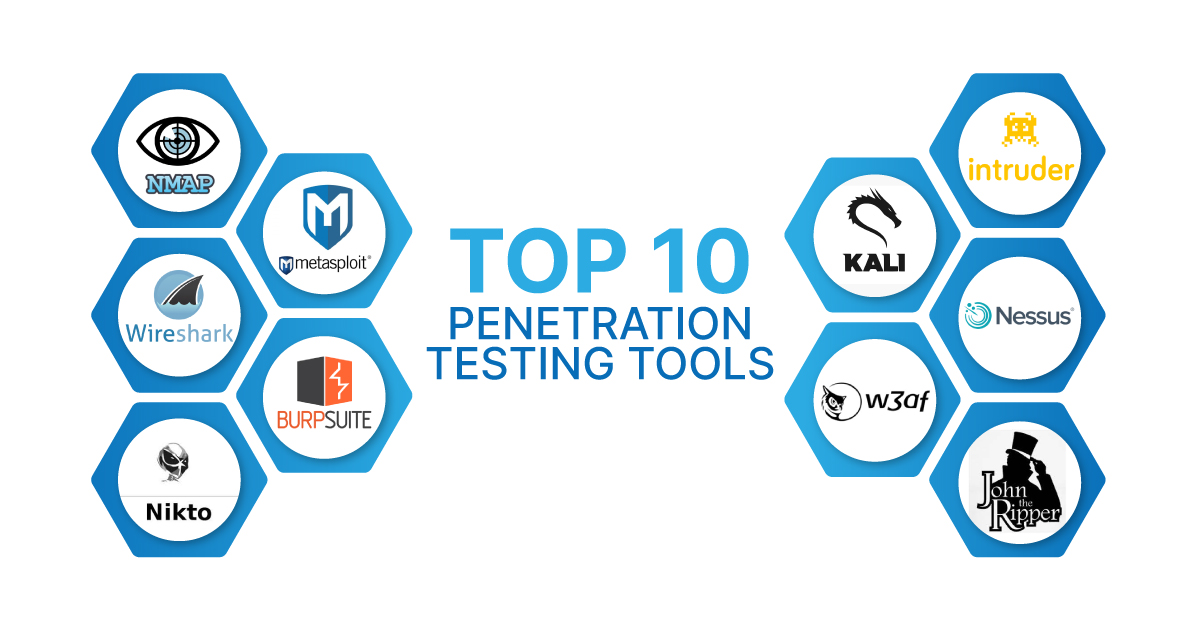
Penetration testing tools are essential for identifying security weaknesses in systems, networks, and applications before attackers can exploit them. These tools help security professionals simulate real-world attacks, assess exposure, and strengthen defenses. Below are some of the most widely used penetration testing tools and techniques.
Commonly known as Network Mapper, Nmap is a free and open-source tool used to discover hosts and services on a network. It is widely used by network administrators and security professionals to identify vulnerabilities and understand network exposure.
Nmap is commonly used to:
Nmap supports multiple scan techniques, each serving a specific purpose.
A TCP scan performs a full three-way handshake with the target system to determine whether ports are open or closed. This scan is considered “noisy” because it is easily logged by services and often triggers intrusion detection systems (IDS).
UDP scans check whether UDP ports are open and listening for connections. Since UDP does not use acknowledgements, scan results may contain false positives. However, UDP scans are useful for identifying Trojans, hidden RPC services, and misconfigured applications. These scans are generally slower due to rate limiting on responses.
Also known as a half-open scan, the SYN scan sends a crafted SYN packet without completing the TCP handshake. Nmap analyzes the responses to determine port status. Because the connection is never fully established, this scan is stealthier than a full TCP scan.
ACK scans are used to determine whether ports are filtered by a firewall. They are particularly useful for mapping firewall rules and identifying whether a firewall is stateful or stateless.
FIN scans send a TCP FIN packet to the target. Many systems respond with a reset (RST) packet if the port is closed. While this method can bypass some IDS systems, it may produce false positives or negatives.
NULL scans send packets with all TCP flags set to zero. Some operating systems, particularly Windows, may not handle these packets reliably, which can result in inaccurate results. However, they may evade basic filtering systems.
XMAS scans manipulate TCP flags such as PSH, URG, and FIN. The scan is named after the “lit-up” flags in the packet header. Windows systems typically do not respond to XMAS scans, making them useful in certain evasion scenarios.
Nessus is a widely used vulnerability assessment tool that leverages the Common Vulnerabilities and Exposures (CVE) framework. It is commonly used during vulnerability assessments and penetration testing engagements.
Nessus works by scanning systems, identifying running services, and testing them for known vulnerabilities that could be exploited by attackers.
Nessus can detect:
Key capabilities include:
Nessus Professional supports internal network scanning and meets PCI DSS requirement 11.2.1.
Burp Suite is an industry-standard tool for testing web applications. It provides a comprehensive framework for analyzing and manipulating HTTP/S traffic between browsers and servers.
The Spider tool crawls web applications to map endpoints and identify attack surfaces. The more endpoints discovered during reconnaissance, the greater the testing coverage during exploitation.
Burp Suite includes an intercepting proxy that allows users to view and modify requests and responses in real time. Requests can be forwarded to other Burp tools without manual copying. The proxy can be configured to filter specific traffic types and run on custom ports.
Intruder is a fuzzing tool used to automate attacks by injecting payloads into parameters. It supports brute-force attacks, dictionary-based attacks, and custom payload testing.
Intruder is commonly used for:
Decoder supports common encoding formats such as URL, HTML, Base64, and Hex. It is useful for analyzing encoded data in headers and parameters and for crafting payloads during testing. Decoder can help identify IDOR vulnerabilities and session hijacking issues.
The Extender feature allows users to install external extensions known as BApps. These extensions enhance Burp Suite’s functionality and can be installed, modified, or removed directly from the interface.
Kali Linux is a powerful penetration testing Linux distribution widely used by security professionals. It is an open-source platform that includes hundreds of pre-installed tools for penetration testing, digital forensics, reverse engineering, and security research.
Kali Linux is especially effective for network attacks, password cracking, and exploitation, though it requires strong TCP/IP and Linux fundamentals to use effectively.
Aircrack-ng is a suite of tools used for Wi-Fi security testing, including:
Hydra is a fast and flexible brute-force password cracking tool. It supports over 50 protocols, including FTP, HTTP, HTTPS, SMB, databases, and more. Hydra is widely used for testing authentication mechanisms.
Wireshark is a free and open-source network protocol analyzer that provides deep visibility into network traffic.
Key features include:
Passwords remain one of the most exploited security weaknesses. John the Ripper is a widely used password cracking tool designed to test password strength and audit authentication systems.
John the Ripper automatically detects hash types and adapts its cracking methods accordingly, making it one of the most effective password auditing tools available.
It supports algorithms such as:
Penetration testing tools play a critical role in identifying vulnerabilities across networks, systems, and applications. While no single tool can cover all attack vectors, using a well-curated toolkit enables security professionals to assess risks effectively, validate defenses, and strengthen an organization’s overall security posture.