




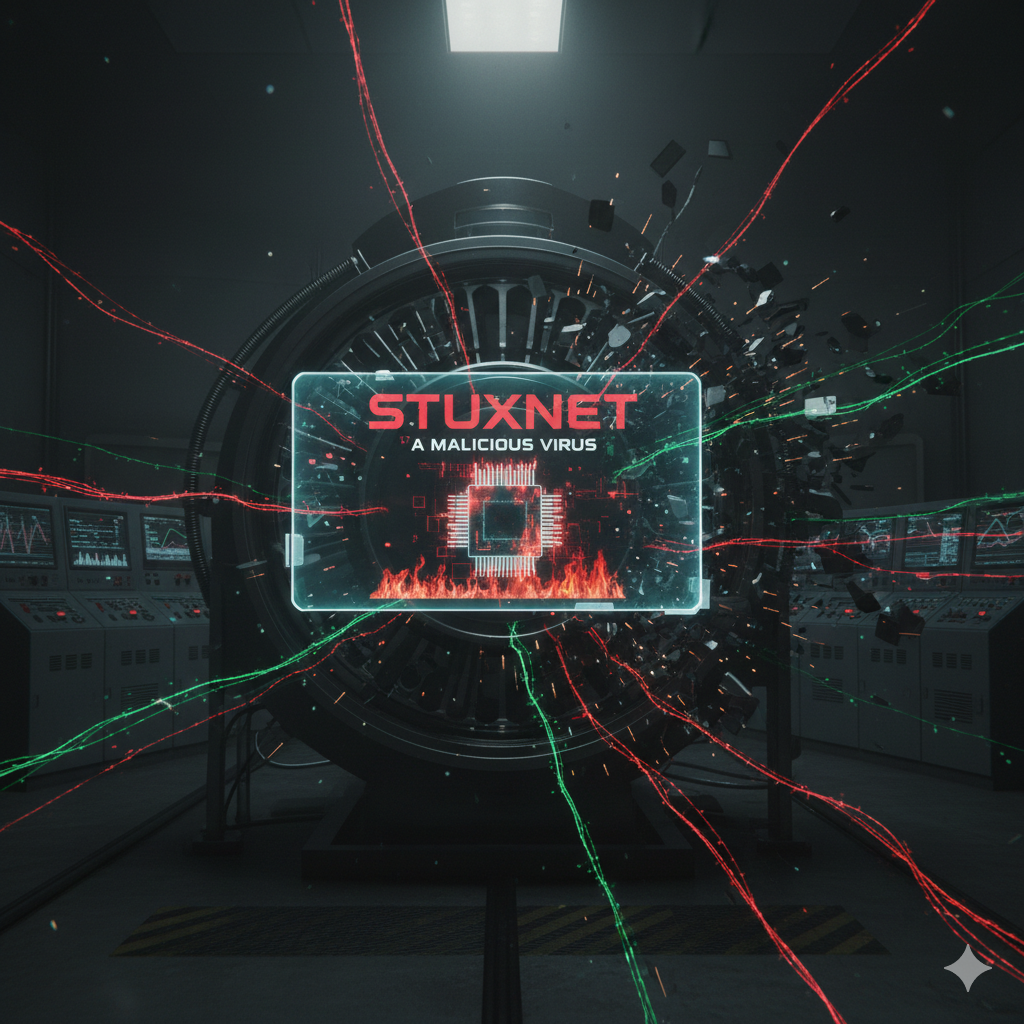
Stuxnet is a highly sophisticated computer worm designed to target industrial control systems (ICS) used to monitor and control large-scale industrial facilities such as power plants, dams, nuclear reactors, and waste processing systems. Unlike conventional malware, Stuxnet enables attackers to manipulate physical equipment without the knowledge of system operators. It was the first known cyber weapon capable of causing direct physical damage to real-world infrastructure, making it exceptionally dangerous.
Stuxnet consists of extremely complex code requiring expertise in software engineering, cybersecurity, and industrial automation systems. Security researchers at Symantec estimated that the development of Stuxnet likely involved a team of five to ten skilled professionals working for at least six months. Additionally, detailed knowledge of industrial control systems and access to such environments for testing strongly suggest that the worm was developed as part of a highly organized and well-funded operation.
Global awareness of cyber threats to critical infrastructure increased dramatically in June 2010 with the discovery of Stuxnet, a 500-kilobyte worm that infected software systems at more than 14 industrial facilities in Iran, including a uranium enrichment plant. Unlike traditional computer viruses that require user interaction to spread, Stuxnet was a worm capable of self-propagation.
Stuxnet operated in three distinct phases. First, it infected Microsoft Windows systems and spread across networks. Second, it searched for Siemens Step7 software, which is used to program industrial control systems. Finally, it targeted programmable logic controllers (PLCs), allowing attackers to manipulate industrial machinery—specifically centrifuges—while simultaneously feeding false data to operators so that the sabotage remained undetected.
Stuxnet was capable of spreading even on computers that were not connected to the internet. It commonly propagated via USB flash drives; once a drive was inserted into an infected system, the worm transferred itself and later infected other machines that accessed the same device. This ability allowed Stuxnet to infiltrate isolated or “air-gapped” networks, a feature that alarmed cybersecurity experts worldwide.
In October 2012, U.S. Defence Secretary Leon Panetta warned of the possibility of a “cyber Pearl Harbor,” where cyberattacks could derail trains, poison water supplies, or cripple power grids. The following month, Chevron became the first U.S. corporation to publicly acknowledge that Stuxnet had infected its internal systems. Although the creators of Stuxnet have never been officially identified, its sophistication strongly indicates the involvement of nation-states. Media reports and leaked information suggest that the United States and Israel were responsible.
Roel Schouwenberg of Kaspersky Lab played a key role in uncovering and analyzing Stuxnet. His involvement brought significant attention to the malware and to Kaspersky Lab itself. Although Kaspersky gained recognition for detecting the worm, it also faced allegations of having ties to the Russian government—claims that the company has consistently denied.
Initially believed to be unrelated, later investigations revealed that Flame was a precursor to Stuxnet. Flame was significantly larger—approximately 20 megabytes—and focused on espionage rather than destruction. It was designed to collect intelligence, including documents, screenshots, audio recordings, and keystrokes.
Flame could spread via USB drives, shared printers, and Bluetooth-enabled devices. It was capable of scanning confidential PDF files for specific keywords and transmitting summaries without detection. Using directional Bluetooth antennas, attackers could even steal data from distances far beyond the standard Bluetooth range. While Stuxnet aimed to sabotage physical systems, Flame functioned as an advanced surveillance tool.
Stuxnet fundamentally changed the global cyber threat landscape by demonstrating that industrial control systems are vulnerable to targeted cyberattacks. Protecting ICS environments from future “Son-of-Stuxnet” threats requires identifying and securing all possible infection pathways, not just obvious ones such as USB devices.
Organizations must adopt comprehensive strategies to document, monitor, and control all electronic data transfers. Even with strong preventive measures, breaches may still occur. Therefore, deploying ICS-specific detection tools, firewalls capable of deep packet inspection, and securing critical last-line-of-defence systems—such as safety-integrated systems (SIS)—is essential.
Stuxnet has proven that cyber warfare is no longer theoretical; it is a present and evolving reality that demands heightened vigilance and advanced security practices.